Country Profile
Kazakhstan is undergoing a fundamental change in the way free roaming dogs may be managed.
The country’s earlier system was presented as being based on capture, sterilisation, vaccination and return. That position has now changed.
Law No. 292‑VIII, adopted on 19 May 2026, amended Kazakhstan’s legislation on the responsible treatment of animals. The relevant provisions came into force in July 2026.
The law expressly permits dogs to be killed as part of regulating the number of stray animals. Cats are excluded from this population control provision.
It also expands the circumstances in which certain unclaimed dogs held in shelters or temporary detention facilities may be killed once the applicable legal conditions have been met.
Local representative authorities have considerable responsibility for determining how population regulation will operate within their territories. Implementation may therefore differ between regions, including the procedures used, applicable holding periods, shelter arrangements and the point at which killing may be authorised.
Kazakhstan is therefore classified as a Crisis Country on the Global Stray Dog Crisis Map while Dog Desk Animal Action monitors how these powers are implemented and what happens to dogs after they are collected.
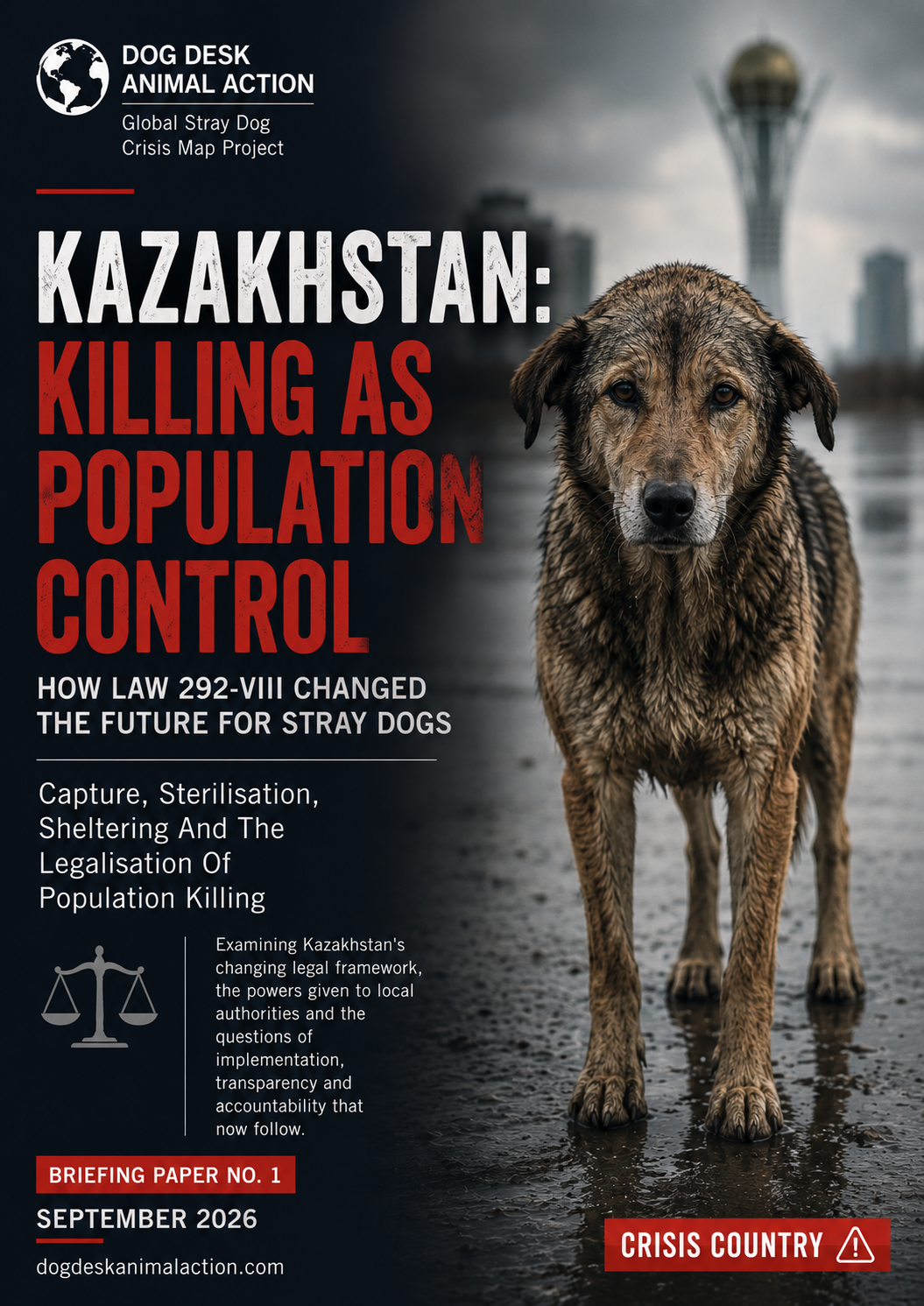
KAZAKHSTAN: KILLING AS POPULATION CONTROL
Briefing Paper 1 September 2026
How Law No. 292‑VIII Changed The Future For Stray Dogs
Kazakhstan’s legal framework for managing stray dogs has fundamentally changed.
Our first Kazakhstan briefing paper examines Law No. 292‑VIII, the earlier animal-welfare framework, the powers now available to local authorities and the circumstances in which dogs may legally be killed.
It considers capture, sterilisation, vaccination, sheltering, temporary detention, adoption and the use of killing as a population-management measure.
The paper also examines the questions that now follow about local implementation, veterinary decision-making, holding periods, shelter capacity, public contracts, individual traceability and the publication of outcomes.
At the centre of the paper is one question:
When killing becomes a lawful population-management tool, what safeguards ensure that it is not used as a substitute for prevention?
WHY WE ARE MONITORING KAZAKHSTAN
The introduction of a legal power does not tell us how frequently that power will be used.
Its consequences will depend upon the rules adopted locally, the capacity of shelters and temporary detention facilities, the availability of sterilisation and vaccination, the effectiveness of adoption and reclaim systems and the degree of independent oversight.
A dog collected from the street should remain individually traceable throughout the system.
There should be a record showing where and when the dog was collected, where they were taken, whether they were checked for identification, what veterinary assessment was performed and what eventually happened to them.
Published totals should distinguish between dogs that were reclaimed, adopted, transferred, sterilised and returned, remained in care, died or were killed.
A reduction in the visible street-dog population is not, by itself, evidence of humane or effective management. Dogs may disappear from the streets through sterilisation and adoption, but also through permanent confinement, unrecorded deaths or killing.
Without individual and aggregate outcome data, those very different results cannot be distinguished.
Removal is an action. It is not an outcome.
Kazakhstan still has the opportunity to invest in prevention through sterilisation, vaccination, identification, registration, responsible ownership, enforcement against abandonment and accessible adoption.
The concern is that legally authorised killing may become a faster administrative response to dog numbers than developing those longer-term systems.
Sources & References
The Kazakhstan Country Profile and associated briefing papers are based on legislation, official legal publications, government and local-authority information, public records, published reporting and other publicly available material relating to stray-dog management in Kazakhstan.
Information is assessed alongside developments documented through the Global Stray Dog Crisis Map Project.
Evidence Types Considered
- National legislation and amendments
- Official publication and commencement information
- Rules and decisions adopted by local representative authorities
- Government and municipal information
- Shelter and temporary-detention arrangements
- Capture, sterilisation, vaccination and population data
- Municipal procurement, contracts and budget information
- Veterinary and euthanasia provisions
- Public statements and official claims
- Published news reports
- Animal-welfare reporting and documentation
Important Note
Dog Desk Animal Action does not conduct law-enforcement investigations and cannot independently verify every reported incident or claim.
Where information originates from media reporting, animal-welfare organisations, campaigners or other third parties, it is presented within that context.
The purpose of the Kazakhstan Country Profile is to document the changing legal framework, examine how the new powers are implemented and identify emerging issues relating to animal welfare, population management, sheltering, killing, transparency and accountability.
Seeking Clarification From Authorities
Dog Desk Animal Action contacts relevant national and local authorities where developments in Kazakhstan raise questions requiring clarification, evidence or further information.
This includes seeking information about local population-management rules, holding periods, capture totals, shelter capacity, sterilisation and vaccination, adoption and reclaim arrangements, municipal contracts and the number of dogs that died or were killed after entering the system.
The purpose of this correspondence is to establish how the law is being implemented and whether every collected dog can be accounted for afterwards.